







JONSN 4th-Generation Mass Production: Ceramic Shaft + Silicon Carbide Composite Sleeve Elevates Gear Pump Lifetime
Preface
Same label, "micro magnetic gear pump" — yet some wear out in 5 months while others run 24 hours non-stop for over 3 years. Behind the price gap lies not just the gears, but a small, easily overlooked component: the bushing. Tracing four generations of technology, this article makes one thing clear: bushing material is the dividing line between micro gear pumps in service life and price.
The Sleeve — the Deciding Factor Behind a Micro Gear Pump's Technology Generation
When judging the quality of a micro gear pump, the industry habit is to look at the gear — whether it is a PEEK gear, whether the body is stainless steel.
In actual operation, however, the "technology generation" of a micro gear pump is defined jointly by three synchronously evolving elements: the gear, the sleeve, and the shaft. Of these, the sleeve is by far the most underestimated link.
It is the most severe friction point in the pump. Every time the gear completes one revolution, one friction event occurs between the shaft and the sleeve. At the operating speeds typical of a micro gear pump, the sleeve endures tens of millions of friction cycles per year — wear begins here first.
It determines clearance, and clearance determines precision. Once the sleeve wears, the fit clearance between gear and pump body is magnified, internal leakage increases, and flow accuracy and pulsation figures degrade accordingly. For metering-type applications — pharmaceutical compounding, electroplating, chromatography, chemical dosing — precision degradation means the process has gone out of control.
It is the magnetic pump's "hidden consumable". In a magnetic gear pump the inner magnet rotor drives the gear through magnetic coupling, so the sleeve carries radial forces and a wear duty more complex than in a conventional pump. Sleeve failure is very often where whole-pump failure begins.
So, to know how long a pump will run and how long its precision will hold, look first at what the sleeve is made of. This is one of those tacit industry consensuses shared by the few manufacturers that actually control the core formulation.
Four Generations of Technology Evolution: From Pure PEEK to SiC Composite Formulation
By gear/sleeve material formulation and by bearing (shaft) technology, the industry's micro magnetic gear pump technology divides cleanly into four generations.
2.1 Four-Generation Overview
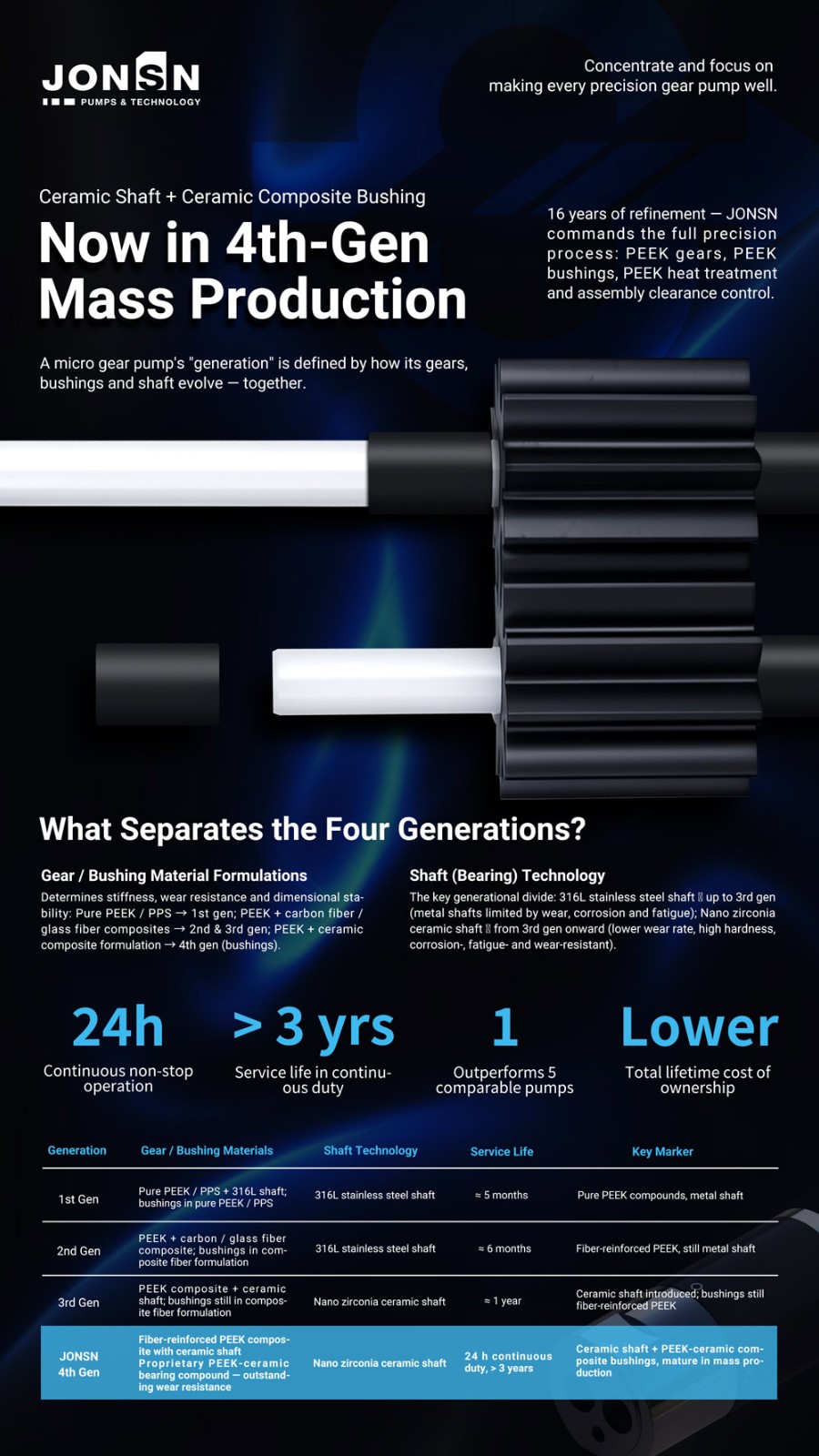
| Generation | Gear / Sleeve Material | Shaft Technology | Service Life | Deciding Point |
|---|---|---|---|---|
| Generation 1 | Pure PEEK + 316L shaft; sleeve in pure PEEK / PPS | 316L stainless shaft | ≈ 5 months | Pure PEEK material, metal shaft |
| Generation 2 | PEEK with glass / carbon fibre reinforcement; sleeve in composite fibre formulation | 316L stainless shaft | ≈ 6 months | PEEK fibre reinforcement, still paired with a metal shaft |
| Generation 3 | PEEK composite fibre + ceramic shaft; sleeve still in composite fibre formulation | Zirconia nano-ceramic shaft | ≈ 1 year | Ceramic shaft introduced — but the sleeve is still PEEK fibre composite |
| JONSN Generation 4 | PEEK composite fibre + ceramic shaft; PEEK-ceramic bearing compound — extremely wear-resistant | Zirconia nano-ceramic shaft | 24h continuous > 3 years | Ceramic shaft + PEEK composite ceramic sleeve, mature at mass production |
2.2 Generation 1 — Pure PEEK + Metal Shaft
Pure PEEK gears paired with a 316L stainless sleeve and a stainless shaft is the industry entry-level solution. Pure PEEK has good self-lubrication and corrosion resistance, but it carries one inherent shortcoming: the material is soft and its wear resistance is limited. Under continuous operation the sleeve bore gradually enlarges, clearance runs out of control, and service life is typically around six months.
2.3 Generation 2 — PEEK Composite Fibre Reinforcement
Adding glass fibre and similar reinforcement phases to PEEK clearly raises hardness and wear resistance, extending lifetime somewhat. But one key detail must not be missed: the shaft in this generation is still 316L stainless steel. With a metal shaft running against a composite sleeve, the wear mode shifts from "sleeve-only wear" to "mutual wear of sleeve and shaft" — and the wear debris enters the process medium. The ceiling remains obvious.
2.4 Generation 3 — Ceramic Shaft Introduced
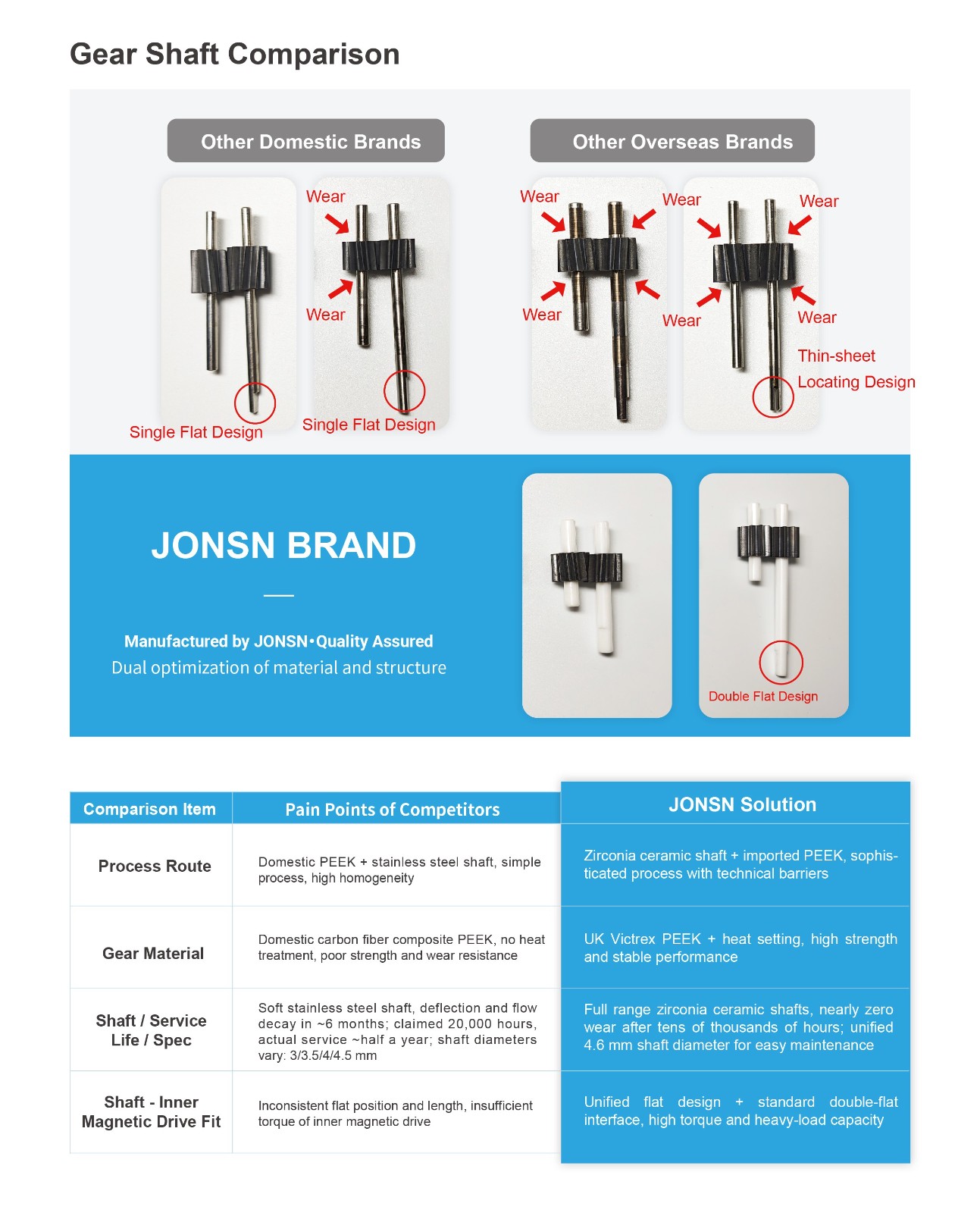
| Comparison Dimension | Industry / Competitor Pain Point | JONSN Solution |
|---|---|---|
| Process route | Domestic PEEK + stainless shaft — simple process, fully homogenised | Zirconia ceramic shaft + imported PEEK — complex process, real technical barriers |
| Gear material | Domestic composite carbon-fibre PEEK, no heat treatment, poor strength and wear resistance | UK Victrex PEEK with heat-treatment conditioning — high strength, stable |
| Shaft / life / specification | Soft stainless shaft: wobble and flow decay after about 6 months; "20,000 h" claimed but actually around half a year; shaft diameters inconsistent at 3 / 3.5 / 4 / 4.5 mm | Full-range zirconia ceramic shaft — tens of thousands of hours with almost no wear; shaft diameter unified at 4.6 mm, easy to maintain |
| Shaft–inner-magnet coupling | Flat profile and length inconsistent; insufficient inner-magnet drive torque | Unified flat + dual-flat standard docking — high torque, heavy-load capable |
The introduction of the zirconia nano-ceramic shaft is a qualitative leap — the ceramic shaft is far harder than stainless steel, and generates very little debris even when running against a PEEK composite sleeve. Lifetime rises to around one year. Yet the bottleneck persists: the sleeve itself is still a PEEK composite fibre formulation, with no targeted wear reinforcement. the weaker, more wear-prone component of the friction pair is still the weak link.
2.5 JONSN Gen 4: PEEK-ceramic bearing compound
Generation 4 completes a "dual-end upgrade" of the friction pair: the shaft is zirconia nano-ceramic, and the sleeve is a PEEK composite silicon-carbide ceramic formulation.
Silicon carbide is an industry-acknowledged hard, wear-resistant material — Silicon carbide is an industry-recognized hard, wear-resistant material, with hardness surpassed only by diamond, boron carbide and a few other superhard materials., and it offers excellent corrosion resistance and high-temperature capability. Blending a high proportion of silicon carbide into the PEEK composite system is, in effect, fitting the sleeve with a suit of wear-resistant armour. This single step is the core support behind the 4th-generation pump's ability to run 24 hours a day without stopping and to break the three-year lifetime barrier.
The JONSN 4th-Generation Formula: Why PEEK-ceramic bearing compound
The "reinforcement phase content" inside the sleeve formulation is each manufacturer's core secret — and the true variable that separates their products apart.
3.1 4th-Generation Sleeve Technical Highlights
| Technical Element | JONSN 4th-Generation Solution | Direct Change Brought |
|---|---|---|
| Sleeve matrix | PEEK composite fibre + ceramic composite system | Balances self-lubrication with structural strength |
| Wear-resistant reinforcement phase | PEEK-ceramic bearing compound | Friction-pair hardness greatly increased, wear rate significantly reduced |
| Mated shaft | Zirconia nano-ceramic shaft | a hard, low-wear, low-debris friction pair |
| Continuous operation capability | 24h continuous non-stop | supports the shift toward continuous, unmanned production |
| Continuous service life | > 3 years | The usage of 3 – 5 lower-generation pumps ≈ 1 Generation-4 pump |
| Process support | Full command of PEEK gears, PEEK sleeves, PEEK heat treatment, and assembly clearance control | Formulation advantage lands as mass-production consistency |
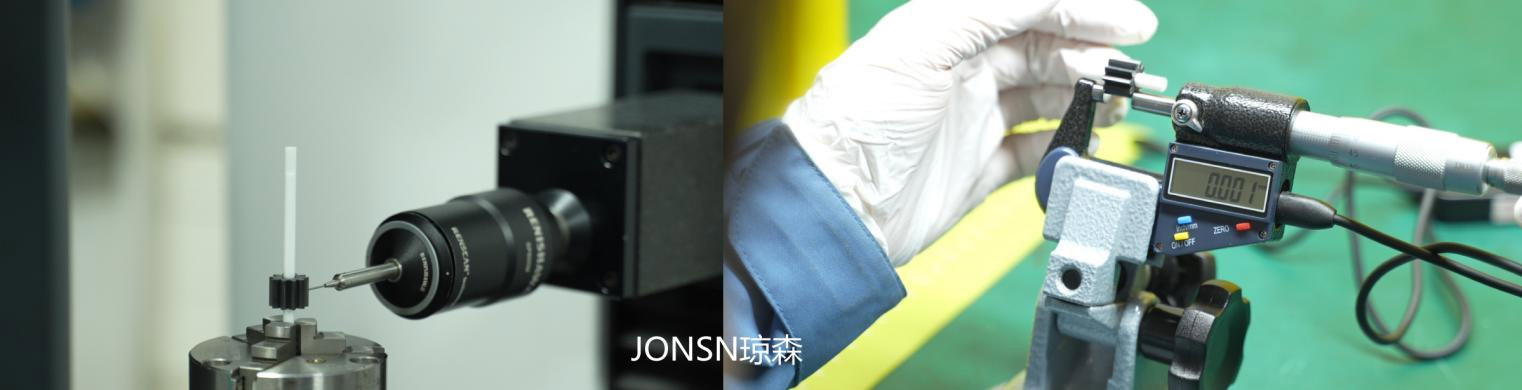
One point must be emphasised: the formulation is only half — process is the other half. A high silicon-carbide content means the material is harder, more brittle and more difficult to machine. The dimensional accuracy of the sleeve bore and the assembly clearance against the shaft must both be guaranteed by precision machining and heat treatment. With 16 years of accumulated technology, JONSN has fully mastered PEEK gear production, PEEK sleeve production, PEEK heat treatment and assembly clearance control. This is precisely why the 4th-generation formulation can be put into stable mass production rather than remaining a laboratory recipe.
3.2 Third-Party Test Verification
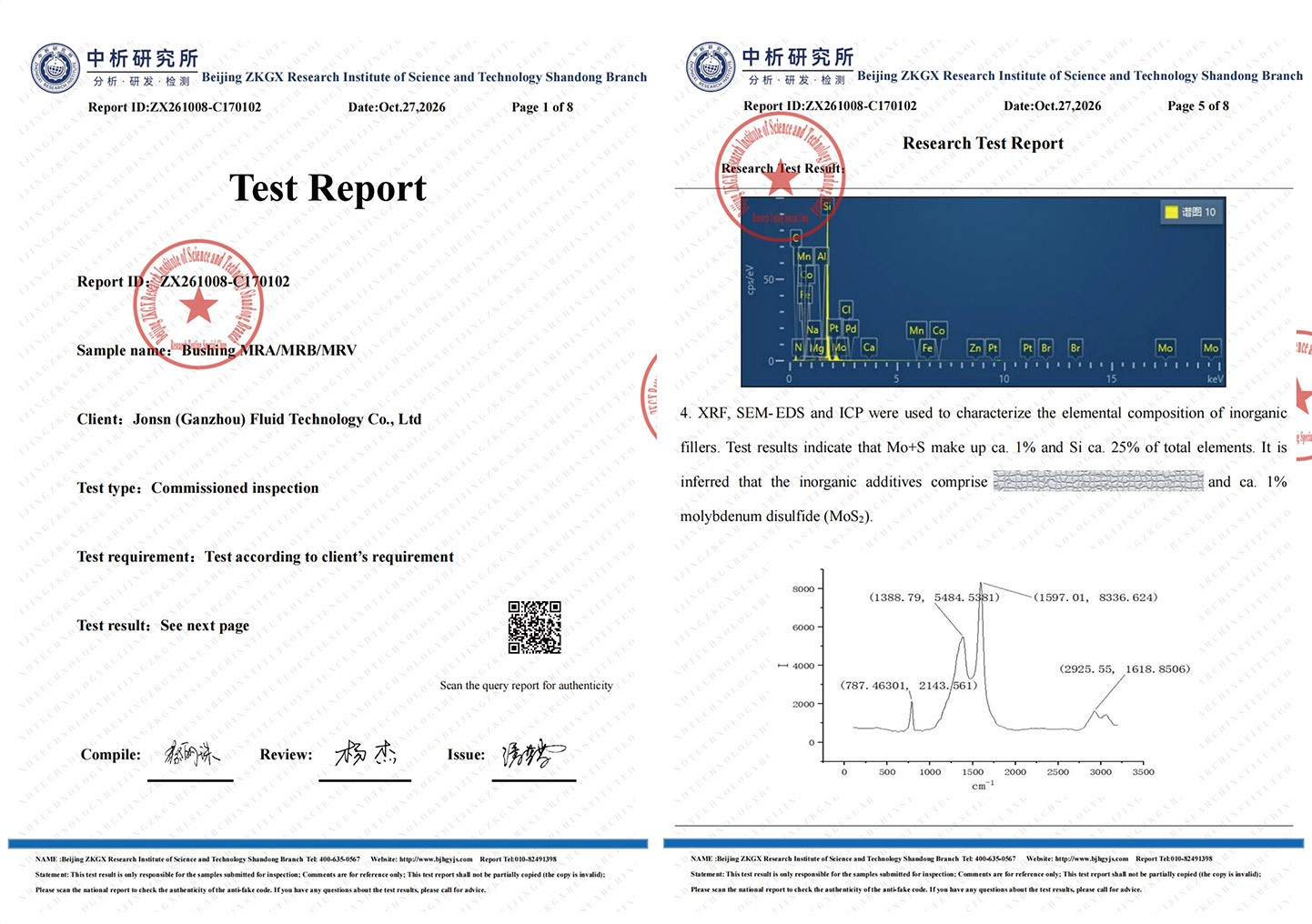
The wear performance and lifetime behaviour of the 4th-generation sleeve formulation have been verified by comparative testing at an independent testing institution — the Zhongxi Research Institute (Beijing Zhongke Guangyan Science & Technology Research Institute, Shandong Branch) — under Report No. ZX261008-C170102. The tested dimensions include composition detection, continuous-operation wear volume, and flow-accuracy decay.
Elemental composition of the inorganic filler was determined by X-ray fluorescence spectrometry (XRF), SEM-EDS and ICP.
Why the 4th Generation "Costs More" but Actually Saves Money
Once the relationship between material and lifetime is understood, the price difference stops being hard to explain — it is fundamentally a life-cycle cost calculation.
4.1 Unit Price versus Life-Cycle Usage Cost
| Cost Item | Lower-Generation Pump (Generation 1, 2) | JONSN 4th-Generation Pump |
|---|---|---|
| Continuous service life | ≈ 5 – 6 months | > 3 years |
| Quantity required over a 3-year cycle | 3 – 5 units (including spares) | 1 unit |
| Replacement downtime | Each replacement requires shutdown, disassembly and re-commissioning | Designed for more than three years of continuous service with reduced replacement and maintenance needs. |
| Precision stability | Precision degrades progressively after wear, requiring frequent calibration | Low wear rate, precision held over the long term |
| Hidden cost | Wear debris entering the medium — a product-quality risk | Very little debris, better assurance of medium cleanliness |
| Life-cycle usage cost | Higher | Lower |
A pump's purchase price accounts for only part of its total life-cycle cost. On a production line running 24 hours a day, every unplanned stoppage typically costs far more than the pump itself. Using one 4th-generation pump with a lifetime of more than three years to replace three to five lower-generation pumps that need replacing annually — that is the most persuasive conversion between "expensive" and "saving".
JONSN has brought its 4th-generation "PEEK-ceramic bearing compound" solution to stable mass production, verified by third-party testing. It is especially suited to long-duration, stable-duty applications: AI server data centers, satellite liquid cooling systems, precision coating systems, and marine methanol-fuel power systems. If you are selecting a pump for continuous duty and high-precision metering, contact JONSN for the 4th-gen bushing test data and sizing advice.
If you are selecting a pump for continuous-duty, high-precision metering service, please contact JONSN for the 4th-generation sleeve test data and selection advisory.