






Space & Orbital Computing
Space Orbital Data Center JONSN Micro Gear Pump Zero-Leakage Thermal Control Solution
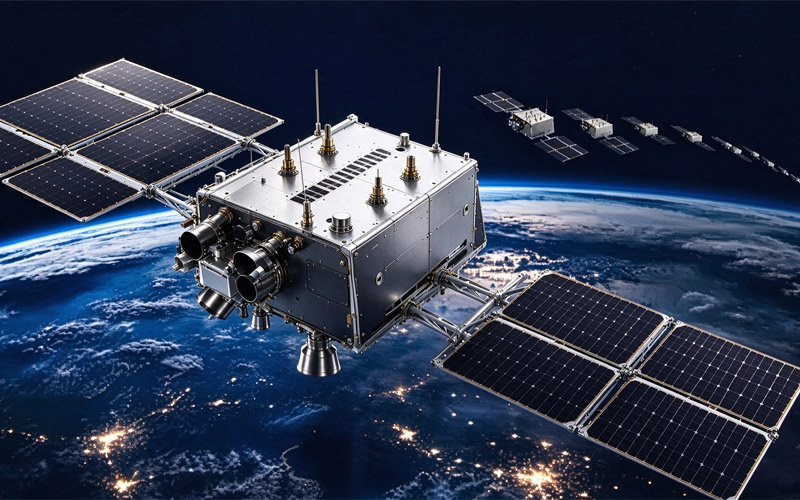
As artificial intelligence computing demand continues to spill over, deploying data centres in low Earth orbit (LEO) is moving from concept toward engineering practice. Orbital data centres, computing constellations and on-board edge nodes leverage the near-unlimited solar energy and the natural deep-space cold background of space to carry high-density compute at a lower PUE.
Magnetic Zero Leakage
The pump cavity and motor are isolated by static sealing, with torque transmitted non-contact by magnetic force, completely eliminating rotating dynamic seals. The entire fluid path has no channel to leak to the environment, and the working fluid is strictly sealed inside the loop — eliminating the space leakage risk at mechanism level.Flow Accuracy ±0.5%
As a positive displacement pump, output flow is linearly determined by rotational speed and is stably supplied within ±0.5% accuracy. Regardless of how cold plate back-pressure varies, flow does not drift with load, making the heat transfer capability of every compute board predictable and simulatable.Pulsation ≤1%
The continuous volume change of gear meshing keeps flow pulsation controlled to ≤1%, producing a uniform cold plate temperature field and small chip junction temperature ripple — particularly suited to advanced packaging and high-bandwidth memory that are sensitive to thermal gradients.Maintenance-Free ≥20,000 h
No dynamic seals, no consumable soft tubing, combined with low-wear gear pairs and long-life bearings, the maintenance-free operating life is designed at ≥20,000 hours, matching the on-orbit mission duration with no personnel intervention required.Introduction: The Orbital Compute Era, Thermal Management as the First Constraint
As artificial intelligence computing demand continues to spill over, deploying data centres in low Earth orbit (LEO) is moving from concept toward engineering practice. Orbital data centres, computing constellations and on-board edge nodes leverage the near-unlimited solar energy and the natural deep-space cold background of space to carry high-density compute at a lower PUE. But the reverse side of the orbital environment is equally severe: microgravity, high vacuum, strong radiation, severe temperature cycling, and the iron rule that nothing can be serviced after launch — every component's reliability is magnified under inspection.
In high-density compute scenarios, the heat dissipation of a single high-compute chip has already reached the hundred-watt level; air cooling fails in vacuum and microgravity, making liquid cooling the only viable thermal management path. And the "heart" of the liquid cooling loop — the circulation pump — must run unattended for long periods under zero leakage, high precision and long service life. This is exactly where JONSN micro magnetic gear pumps enter orbital computing infrastructure.
Deficiencies of Conventional Pumps in Space Liquid Cooling
Conventional industrial pumps perform well on the ground, but once they enter a space liquid cooling loop, their inherent shortcomings are significantly amplified:
JONSN Micro Gear Pump Advantages
JONSN micro magnetic gear pumps are built around "positive displacement + magnetically coupled full enclosure" and systematically optimised against the key constraints of space liquid cooling. The advantages can be summarised in six points:
Parameter Validation and Application Cases
Core Parameters (JONSN-MPG Series)
| Item | Specification |
|---|---|
| Rated Flow | 100 mL/min |
| Maximum Outlet Pressure | 10 bar |
| Flow Accuracy | ±0.5% |
| Flow Pulsation | ≤1% |
| Sealing Form | Magnetically coupled full enclosure (zero leakage) |
| Compatible Media | Deionised water, water-glycol, electronic fluorinated liquid, ammonia, etc. |
| Operating Temperature Range | -40 °C ~ +120 °C (pump body) |
| Drive Voltage | 12 / 24 VDC (customisable) |
| Rated Power Consumption | ≤15 W |
| Unit Mass | ≤480 g |
| Design Life | ≥20,000 h (maintenance-free) |
| Interface Form | Compression fitting / quick-connect (customisable) |

Validation Testing
JONSN-MPG series must pass a set of on-orbit-environment reliability validations before entering space applications:
Application Case (Representative Illustration)
Conclusion
Orbital data centres push the boundary of compute into space, and place reliability demands on every basic component that the ground era never imagined.
JONSN micro magnetic gear pumps provide a trustworthy "heart" for space liquid cooling loops through their zero-leakage, high-precision, low-pulsation and long-life maintenance-free characteristics.
If your computing constellation, on-board edge node or space thermal control system is selecting a circulation pump, please contact the JONSN technical team for parameter matching and customised solutions tailored to your mission profile.
Frequently Asked Questions
Can gear pumps work normally in a microgravity environment?
Yes. JONSN micro gear pumps use a positive displacement structure that transports working fluid through gear volume change, and do not rely on gravity for drive. Magnetically coupled with no dynamic seals, there is also no cavitation-sensitive axial sealing interface, so flow remains stable and operation reliable under microgravity and high vacuum.
Which coolants are supported?
Compatible with deionised water, water-glycol, electronic fluorinated liquid (such as perfluorinated compounds) and ammonia — mainstream aerospace thermal control media. Pump cavity contact materials use stainless steel, PEEK and ceramic, offering good chemical compatibility and low outgassing characteristics.
How is radiation resistance?
The standard version has basic radiation tolerance. For long-duration low Earth orbit missions, radiation-hardened driver circuits and hardened electronics options are available to match the project's total ionizing dose (TID) budget.
Is the power consumption high?
At 100 mL/min and 10 bar the rated power consumption is ≤15 W, a friendly position within the satellite power budget, helping allocate more electrical power to the compute load.
What is the operating temperature range?
The pump body operating temperature covers -40 °C to +120 °C, adapting to the full mission profile including ground standby during the launch phase, thermal shock in the ascent phase and on-orbit hot-cold cycling.
How long is the service life, and can it be serviced on orbit?
The design maintenance-free operating life is ≥20,000 hours. Because servicing on site in space is impossible, the pump uses a structure with no dynamic seals and no consumable soft tubing — life equals the usable cycle of the system, matching the on-orbit mission.
Is customisation supported?
Yes. Drive voltage, fluid interface, contact materials and flow specifications can all be customised per project requirements, with small-batch space-grade screening and batch traceability supported.
What is the advantage over centrifugal or peristaltic pumps?
The core difference lies in the combination of "zero leakage + low pulsation + high precision + lightweight long life": centrifugal pumps carry dynamic seal leakage risk and perform poorly at small flow, while peristaltic pumps pulsate heavily and use consumable tubing. JONSN micro gear pumps offer better overall suitability in the non-serviceable space scenario.