




Where to Find a Reliable Micro Gear Pump Manufacturer in 2026: A Buyer’s Map
You can find a reliable micro gear pump manufacturer in 2026 by checking candidates against hard evidence, not brochures. Micro gear pumps are precision parts. One wrong supplier brings downtime, tolerance drift, rework, and hidden costs that show up long after the purchase order.
This guide works as a practical buyer's map. You get the criteria to apply, the verification steps to run, and a clear path from shortlist to signed partnership. The advice reflects current 2026 sourcing conditions. First-time buyers and seasoned procurement teams can both use it to structure vendor selection with confidence.
Start with your application requirements. Then demand proof. That sequence separates a reliable micro gear pump manufacturer from a persuasive one.
Key Takeaways
Check the precision data and lot-to-lot consistency to make sure the pump performs reliably.
Check for ISO 9001 and ask for inspection records to make sure quality is managed well.
Check how quickly technical support responds to judge the quality of after-sale support.
Pick pump specs that fit what your job needs for flow, pressure, and materials.
Make sure quotes are standard, and think about the total cost of ownership to avoid hidden expenses.
Why Manufacturer Reliability Matters
The Cost of an Unreliable Supplier
A weak supplier creates costs that never show up on the quote. A pump that drifts outside its tolerance band makes you rework assemblies and scrap finished units. Rework also uses up production capacity you already sold. One missed delivery can stop a hydraulic assembly line for a whole shift. Then you pay for expedited freight to get back on schedule. If the vendor changes a gear profile without telling you, you start qualification over from scratch. That restart uses up engineering hours, test samples, and customer approvals. In hydraulic systems, one seal failure can contaminate a whole circuit and cause a costly flush.
These losses add up. Downtime spreads to stations further down the line. Tolerance drift means more inspections and slower throughput. Contaminated hydraulic fluid adds filtration cost and repeat flushing. You absorb the cost of air freight, overtime, and customer expediting fees. Each incident cuts into your margin and your credibility with your own customers. Buyers who pick micro gear pumps on price alone often learn this math too late.
What a Trusted Partner Delivers
A trusted micro gear pump manufacturer gives you four things: steady precision, documented quality, quick support, and lead times you can count on. Steady precision means every lot meets the same tolerance band. Documented quality means inspection records come with each shipment. Quick support means an engineer answers your application question in hours, not weeks. Lead times you can count on let you plan hydraulic equipment builds without extra stock. You get a supply chain you can forecast.
Reliability also shows up in small habits. A steady supplier points out process changes before they ship. They keep calibration schedules up to date. They treat your hydraulic circuit requirements as engineering inputs, not order details. That discipline produces reliable pumps you can specify with confidence. Over time, steady and reliable pumps lower your total cost and protect your production schedule. A gear pump from a partner like this becomes one less variable in your process.

Key Criteria for a Reliable Micro Gear Pump Manufacturer
Precision and Quality Consistency
Before you talk about price, ask every candidate for four numbers. Repeatability shows how tightly the pump repeats the same dose. Linearity shows how closely output follows the command across the full range. Tolerance bands show what the factory accepts at inspection. Lot-to-lot consistency shows whether pump ten from this month matches pump ten from last quarter. A reliable micro gear pump manufacturer publishes these figures and backs them with data.
JONSN shows what strong evidence looks like. The company says critical machining tolerances stay within ±2 µm. It reports repeatability of ±0.2% and linearity accuracy of ±0.5%. It also checks parts on German ZEISS coordinate-measuring machines. These are claims you can check, not slogans. Ask each supplier for the same kind of proof. Request inspection reports from recent lots. Compare the spread across three shipments. That comparison shows whether high repeatability holds in production or only in a lab demo.
Consistent quality also depends on process control. Ask how the factory calibrates its gauges and how often. Ask what happens when a lot fails inspection. A supplier with a clear answer protects your hydraulic assembly line from surprise drift. A supplier with a vague answer shifts that risk onto you.
Technical Expertise and Application Support
Precision alone does not make a pump fit your system. Application engineering separates a parts vendor from a true micro gear pump manufacturer. Suofu's published guidance describes the standard method. You determine required flow rate, differential pressure, fluid viscosity, and intended motor speed. You use pump displacement to estimate theoretical flow. Then you check actual performance against the manufacturer's curves. A strong partner runs this calculation with you and shares the curves.
Customization depth matters just as much. Suofu notes that OEM and ODM programs cover pump displacement, motor type and speed control, wetted materials, inlet and outlet connections, mounting dimensions, and electrical integration. Motor choice deserves attention. Brushless DC, stepper, servo, and AC options all exist, and motor torque must suit your differential pressure and viscosity. Installation details also shape performance. Confirm the pump body envelope, port sizes, and motor length. Keep inlet piping short and straight, and specify suitable filtration.
JONSN supports this work with selection data, layout drawings, CAD files, and STEP models. Those files shorten your design cycle and reduce integration errors. When you screen micro gear pump manufacturers, test whether the engineering team answers in depth or deflects to sales. A partner who questions your duty cycle and fluid chemistry is worth more than one who only quotes a price. That dialogue is where product quality gets designed in, not inspected in later.
Certifications and Quality Signals to Verify
Standards That Matter for Micro Gear Pumps
A certificate starts the talk. Records finish the deal. Tidepump's sourcing guidance says this clearly: ISO 9001 certification shows process discipline, but a certificate by itself proves very little. The real evidence is in the records behind it. For micro gear pumps, you want paperwork in four groups.
Standard / Signal | What to Request |
|---|---|
ISO 9001 | Current certificate plus the audit scope |
Batch traceability | Lot numbers linked to production and material records |
Material certificates | Mill certs and inspection records for each batch |
Calibration records | Gauge schedules and documented corrective actions |
Add RoHS, REACH, and product safety declarations when your market or final equipment requires them. Pick your paperwork based on the rules of the market you ship into. A hydraulic equipment builder selling into Europe needs different documents than a domestic integrator. A hydraulic integrator running continuous duty needs tighter records than a lab buyer running short batches.
Reading a Quality Management System
A quality management system is a working record, not a wall plaque. Ask for the latest audit report and read the findings, not just the score. Request corrective-action records from the past year. Those records show how the factory responds when something fails. Check the calibration schedule for the gauges that set your tolerance band. Then ask for incoming-inspection data on raw materials. For hydraulic service, ask how the factory traces a failed lot back to its heat number.
Compare that data against the material certificates. The two should match. A supplier who shares these documents freely is protecting your product quality. A supplier who offers only a certificate image is protecting a brochure. Your hydraulic assembly line depends on that discipline.
Ask for documentation instead of trusting marketing claims. Put the request in your RFQ so every candidate answers the same way. That one step filters your shortlist fast, and it shows you which vendors treat hydraulic system reliability as an engineering commitment rather than a slogan.
Screening Micro Gear Pump Manufacturers on Reputation
Verifying Track Record and References
Reputation gives you a quick way to filter vendors. Ask each candidate for three references from customers with applications like yours. Call those references and ask about delivery performance, lot-to-lot consistency, and how the supplier handled a problem. Repeat-purchase rate is another strong signal. JONSN cites a repeat-purchase rate of up to 86.5% and more than 2,000 integrators and OEMs served. Treat figures like these as a starting point, then check them with your own reference calls.
Customer concentration is worth a look too. A supplier with a balanced customer base is less at risk if one account leaves. Well-known names such as Micropump, HNP Mikrosysteme, Diener, Suofu, and NAPCO come up often in market talks. Use them as context for comparison, not as automatic targets. A smaller specialist can serve you better than a large brand when your hydraulic application needs custom work.
Support Responsiveness as a Signal
Test customer support before you sign anything. Hydrogear Tech advises buyers to send a detailed inquiry and measure how quickly and thoroughly the supplier responds. That response predicts post-sale support quality. Watch for three things: response time, engineering depth, and willingness to share data.
Test technical support responsiveness: Send a detailed inquiry and measure how quickly and thoroughly they respond — this predicts post-sale support quality
A trusted manufacturer answers with engineering content, not a price sheet. Ask a question about hydraulic fluid viscosity or duty cycle. A strong reply cites test data and asks about your system. A weak reply pushes you to sales. Willingness to share inspection records and calibration schedules also separates trusted manufacturers from talkers. Run this test on every micro gear pump manufacturer on your list. The results will reshape your shortlist fast, and they will tell you which micro gear pumps supplier deserves your hydraulic business.
Matching Micro Gear Pumps to Your Application
Flow, Pressure, and Viscosity Requirements
Begin your selection with five factors: flow range, differential pressure, viscosity, temperature, and duty cycle. Each one helps narrow the field. The flow you need sets the pump size. Differential pressure tells you how much motor torque is required. Viscosity shapes the speed curve, and the usual range runs from 0.4 to 3,000 mPa·s. Temperature affects clearances and seal choice. Duty cycle decides whether you need continuous-rated parts or intermittent service.
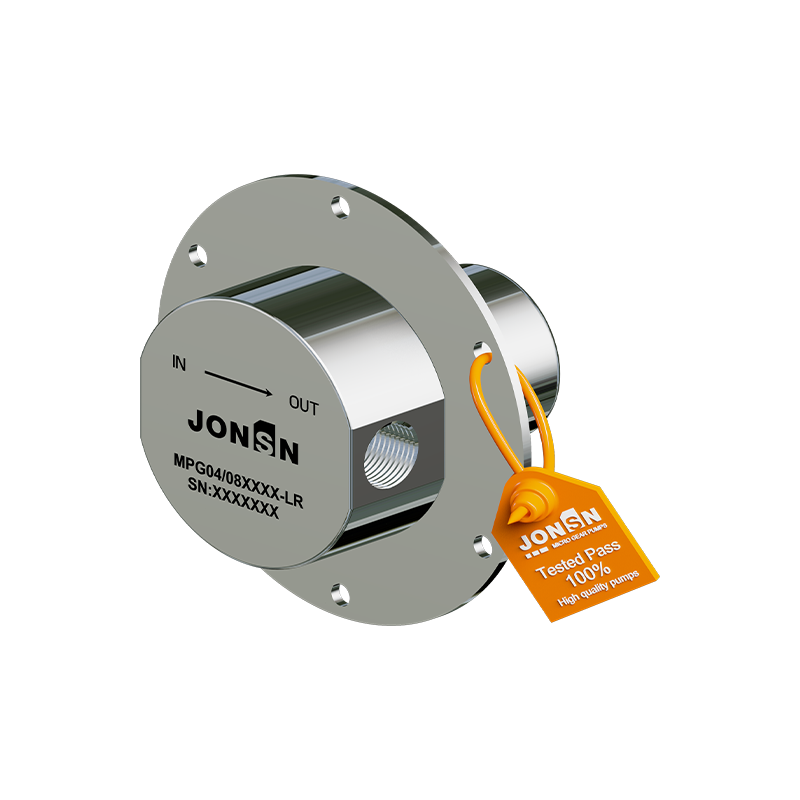
The JONSN Precision Micro Gear Pump family shows how one platform covers a wide span. The MPG series handles roughly 1–280 ml/min depending on configuration. The MRA covers 100–2,000 ml/min, the MRB 400–4,800 ml/min, and the MRC 0.8–14 L/min. The MRE runs 4–48 L/min, the MRF 8–67 L/min, and the MRV 0.2–8 L/min. The MDC dosing station extends control from 1 to 10,000 ml/min with a paired pump head. Together these series span about 1 ml/min to 67 L/min.
Series | Flow Range |
|---|---|
MPG | ~1–280 ml/min |
MRA | 100–2,000 ml/min |
MRB | 400–4,800 ml/min |
MRC | 0.8–14 L/min |
MRE | 4–48 L/min |
MRF | 8–67 L/min |
MRV | 0.2–8 L/min |
Match the series to your operating point, then confirm the pressure rating. Several series reach differential pressures near 25 bar, and maximum pressure resistance is generally 4 MPa. The MRE series lists up to 6 MPa. Check these figures against your hydraulic circuit before you commit.
Materials and Media Compatibility
Wetted materials decide whether a gear pump survives your fluid. Standard JONSN construction uses SS316L stainless steel and Hastelloy C-276. Selected models add PEEK gears and zirconia ceramic shafts. These choices support chemical compatibility and wear resistance in demanding service. Magnetic-drive configurations isolate the medium from the drive assembly and deliver leak-free operation for sensitive fluids.
Weigh flow, pressure, and materials together, not one at a time. A corrosive medium may push you toward Hastelloy C-276. A compact enclosure may push you toward the MRV series. A hydraulic application with tight space and steady duty needs both answers at once. Ask your supplier to confirm compatibility for your exact fluid, concentration, and temperature. That check protects flow precision and supports stable low-flow performance over the full service life. Buyers who want long-lasting micro gear pumps treat material selection as an engineering decision, not an afterthought. Accurate metering and consistent micro-dosing both depend on it.
Practical Steps to Qualify a Micro Gear Pump Manufacturer
Facility Visits and Sample Testing
A facility visit lets you see facts instead of claims. Bring a checklist as you walk the floor. Check the machining capability first: look at the gear-cutting and grinding equipment, and ask which machines hold your tolerance band. Next, check the metrology equipment. A factory that verifies parts on a ZEISS coordinate-measuring machine can prove its numbers. Inspect assembly cleanliness, because contamination ruins precision. Last, review process documents at the workstation, not in a conference room. A micro gear pump manufacturer that keeps inspection records beside the line is one you can audit.
Sample testing follows a set protocol. Define acceptance criteria before the first sample ships. Put your flow range, differential pressure, viscosity, and duty cycle in writing. Test at your real operating points, not at a convenient bench setting. Measure repeatability over time: run the same dose across several sessions and compare the spread. Track linearity across the full range. Write down every deviation. A vendor selection process built on data beats one built on impressions.
Quotes, Lead Times, and Total Cost
Quotes rarely compare cleanly. Normalize them before you decide. Ask every supplier to quote the same tolerance band, the same motor option, and the same warranty terms. Then compare lead times and the total cost of ownership, not just the unit price.
Quote Item | What to Normalize |
|---|---|
Tolerance band | Same inspection limit for every bid |
Motor option | Same type and control method |
Lead time | Stated in weeks, with expedite terms |
Warranty | Same duration and coverage |
Total cost | Spares, freight, and downtime risk |
A low price with a loose tolerance band hides rework cost. A short lead time with no written promise hides schedule risk. Ask each supplier to state lead time in weeks and to confirm expedite terms in writing. Compare warranty coverage line by line. Add in spares and freight. Then weigh the downtime risk of an unproven supplier. Reliable pumps cost less over their service life, even when the invoice is higher.
Test customer support during this stage. Send a follow-up question about hydraulic fluid compatibility or hydraulic circuit pressure. Time the reply. A supplier who answers with engineering content earns a place on your shortlist. A supplier who pushes you to sales does not. Run this test on every candidate, and let the results guide your hydraulic equipment sourcing decision. The right partner protects your hydraulic assembly schedule and your hydraulic system reliability.
Market Context for Hydraulic Gear Pump Sourcing in 2026
What Buyers Should Know About Supply
Two market reports give you a helpful starting point for planning. Mordor Intelligence says the global gear pump market is worth USD 5.04 billion in 2026. It should grow 2.93% a year to USD 5.82 billion by 2031. Future Market Insights puts the hydraulic gear pump segment at USD 2.2 billion in 2026. That segment should reach USD 3.4 billion by 2036, growing 3.7% a year. The segment report also says external gear pumps held 55.0% share in 2026, and the 15 to 50 bar band made up 29.0%.
Metric | Value |
|---|---|
Global gear pump market (2026) | USD 5.04 billion |
Global forecast (2031) | USD 5.82 billion |
Global CAGR (2026–2031) | 2.93% |
Hydraulic gear pump market (2026) | USD 2.2 billion |
Hydraulic forecast (2036) | USD 3.4 billion |
Hydraulic CAGR (2026–2036) | 3.7% |
These numbers matter in a real way for hydraulic system procurement. Steady growth means demand stays strong, and strong demand makes lead times longer for popular setups. You should expect longer waits for standard hydraulic gear pump models and plan for them in your hydraulic builds. Dual-sourcing protects you here. Qualify a second hydraulic component supplier before you need one, not after a delay hits your line. Early qualification also gives you time to test samples and review records without schedule pressure.
Treat this market data as background, not a forecast you can count on. The reports describe current size and recent growth rates. They do not promise smooth supply in every region or product class. Your best defense is a shortlist of qualified vendors and a written qualification file for each. Review each file before you place a production order. That habit serves hydraulic system procurement well in any market condition. A reliable hydraulic component supplier earns a place on that list through evidence, and the market numbers simply tell you why the list matters.
Building a Long-Term Partnership with JONSN
From First Sample to Stable Supply
A strong supplier relationship grows in clear steps. JONSN brings over 16 years of R&D and manufacturing experience to this path. It also has ties with more than 2,000 integrators and OEMs. You can follow the same steps with confidence:
Sample qualification: test a pump at your real operating points. Then confirm repeatability and linearity meet your acceptance criteria.
Pilot order: run a small batch through your hydraulic assembly line. Check that each lot matches the last.
Ramp-up: raise volumes while you track lead times and inspection records.
Stable supply: settle into a steady schedule with agreed review points.
Customization support makes each step easier. JONSN gives you selection data, layout drawings, CAD files, and STEP models for its micro gear pumps. Your engineers can drop these files into a hydraulic system design. They can check the fit before any hardware ships. That shortens integration time and cuts errors on the hydraulic circuit.
Communication and Continuous Improvement
Partnership habits decide long-term performance. Set a communication schedule early, like a monthly review of delivery, quality data, and open engineering questions. Ask for written change notice before any process, material, or tolerance update reaches your hydraulic orders. That notice keeps your hydraulic qualification file safe from surprise restarts.
Treat customer support as a two-way channel. Share field data on hydraulic performance, duty cycle, and dosing accuracy. A reliable manufacturing partner uses that feedback to refine designs and tighten process control. JONSN's customization team can then adjust drawings or motor options for your next hydraulic build. Review corrective actions together each quarter. This rhythm keeps your hydraulic supply stable and your partnership productive.
Reliability comes from clear rules, real proof, and testing. Marketing claims prove nothing. You now have a buyer's map: define what your application needs, screen candidates on quality and technical fit, confirm certifications and references, then validate with samples and a facility review. Use this checklist on your shortlist. A reliable micro gear pump manufacturer will welcome the close look.
JONSN offers micro gear pumps for hydraulic builds, plus selection data and STEP models for your hydraulic designs. Their team supports hydraulic applications from first sample to stable supply. Treat hydraulic sourcing as an engineering project, and your hydraulic equipment will reward you.
Request a consultation, sample, or quote from JONSN to start qualification for 2026.
FAQ
How do you start qualifying a micro gear pump supplier?
Send a detailed inquiry that lists your flow, pressure, viscosity, and duty cycle. Time how fast they reply and judge how deep their engineering answer goes. Then ask for inspection records, calibration schedules, and recent lot data. JONSN answers technical questions at sales@JONSN.com and shares selection files when you ask.
Which documents should you request first?
Ask for the ISO 9001 certificate and the audit scope that goes with it. Add lot traceability records, material certificates, and gauge calibration schedules. Request corrective-action records from the past year. Compare that paperwork against incoming-inspection data. Suppliers who share these documents freely give you a quality file you can check.
How do you compare quotes from different manufacturers?
Normalize every bid before you judge the price. Set the same tolerance band, motor option, warranty terms, and lead-time format for all candidates. Add spares, freight, and downtime risk to the unit price. A higher invoice with documented precision often costs less across the service life.
Can JONSN customize a pump for your system?
Yes. JONSN supports non-standard configurations across its Precision Micro Gear Pump family. You can specify wetted materials such as SS316L or Hastelloy C-276, motor type, and connections. The team supplies selection data, layout drawings, CAD files, and STEP models to speed up your integration work.
What support do you get after the first order?
Expect a sample qualification step, then a pilot order, then ramp-up to stable supply. Set a review rhythm for delivery and quality data. Ask for written change notice before any process or tolerance update. JONSN's customization team adjusts drawings and motor options as your design evolves.