




Coating, Printing & Precision ManufacturingCoating, Printing & Precision Manufacturing
Coating, Printing & Precision Manufacturing

Adhesives & Polymers Application

2026-11-25
View:8
Applications · Coating, Printing & Precision Manufacturing · Adhesives & Polymers

Quantitative Conveying and Precise Coating of High-Viscosity Adhesives

JONSN DP series high-precision gear metering pump application scheme — polyurethane, two-component adhesives, acrylics, resins, bitumen and silicones.
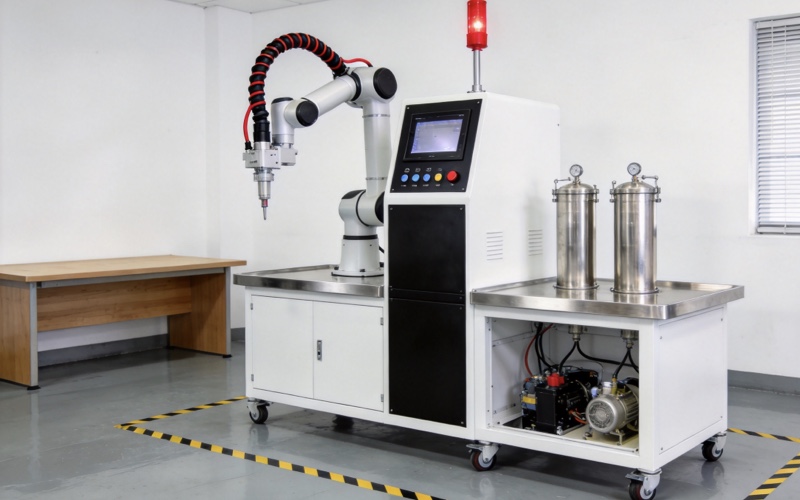
DP · High-precision gear metering pump
Flow set by geometric displacement
Continuous output, low pulsation
High back pressure and high temperature
Two pumps synchronized into a ratio system
矩形 6备份 12.jpg
Content Summary

Polyurethane, two-component adhesives, acrylics, resins, bitumen and silicones are a common class of process media on coating, printing and precision manufacturing lines. Their viscosity extends from several hundred mPa·s to 500,000 mPa·s; some of them are still flowable at room temperature, others are semi-solid materials that can only be conveyed with heat tracing. What they share is this: the glue output directly determines the adhesive layer thickness and the curing ratio, so any flow drift shows up as a visual or structural defect of the product. The JONSN DP series high-precision gear metering pump addresses the medium- and high-viscosity range of 100–500,000 mPa·s, with an outlet pressure of up to 70 bar, providing continuous quantitative conveying and coating for these media.

I. Media Characteristics and Differences in Duty

Media
Conveying Media · Common Duty Characteristics · Metering Concerns
Conveying MediaCommon Duty CharacteristicsMetering Concerns
PolyurethanePolyol and isocyanate conveyed on separate lines, used for foaming and potting; the viscosity of the raw material varies clearly with temperatureStable A/B ratio, no loss of supply when the viscosity rises at low temperature
Two-component adhesivesEpoxy, silicone and polyurethane systems, often filled; the viscosities of the A/B components differ greatly and curing starts after mixingThe two flows are proportional and synchronous, reducing ratio drift and in-pump curing residue
Acrylic adhesive dispensingSingle-point dispensing volume small, takt fast, start-stop frequent; the bead width and appearance are sensitiveLow pulsation and fast response, less glue build-up, breakage and stringing in the start-stop sections
ResinsEpoxy and unsaturated polyester, used for coating, casting and impregnation, often requiring heating to reduce viscosityFlow stays linear at constant temperature, so the coating thickness is consistent
BitumenConveyed at high temperature with heat tracing, high viscosity, possibly filled, high resistance in the linePressure resistance and wear resistance, stable output over a long line
Silicone quantitative coatingHighly thixotropic; seal strip and surface coating require continuity, and residue is left after a line stopContinuous output without interruption, pump chamber structure easy to clean and to change over

II. Common Conveying Pain Points

Pressure pots and pneumatic supply structures are simple, but the glue output is affected at the same time by the pressure fluctuation, the liquid level height and the adhesive temperature change, so the same set of parameters often gives a different glue amount in different batches; plunger and pneumatic diaphragm pumps have stroke pulsation, which easily forms beads of uneven thickness during continuous coating, and causes glue build-up or glue breakage at the instant of start-stop in dispensing. In a two-component system, if the two lines use different supply principles or are regulated independently, the actual A/B ratio will deviate from the set value as the viscosity changes, which in turn affects the curing speed and the performance of the adhesive layer.

In addition, adhesives containing fillers such as silicone micropowder or calcium carbonate have an abrasive effect on the gears and the shaft seal; high-temperature bitumen and hot-melt type resins also involve heat tracing and shutdown residue. Seal wear, pump chamber scaling and batch-to-batch supply fluctuation are usually the main sources of unplanned downtime and adhesive waste on such lines.

Pressure and level influence the output
The glue output is affected at the same time by the pressure fluctuation, the liquid level height and the adhesive temperature change, so the same set of parameters often gives a different glue amount in different batches.
Stroke pulsation and start-stop defects
Plunger and pneumatic diaphragm pumps have stroke pulsation, which easily forms beads of uneven thickness during continuous coating, and causes glue build-up or glue breakage at the instant of start-stop in dispensing.
Ratio drift in two-component systems
If the two lines use different supply principles or are regulated independently, the actual A/B ratio will deviate from the set value as the viscosity changes, which affects the curing speed and the performance of the adhesive layer.

III. What the Process Asks of a Metering Pump

Mapped onto the equipment side, the requirements are concentrated in four points: the flow is determined by the geometric displacement and is basically unaffected by viscosity, back pressure and level fluctuation; the output is continuous and low-pulsation, which reduces the need for additional valves and buffer elements; the pump head tolerates high back pressure and high temperature, and the form of sealing and the surface treatment can be selected according to the medium; and in the two-component case, the displacement and speed of the two pumps can be set independently and driven synchronously, so that a ratio system can be formed directly.

1
Flow determined by geometric displacement
The flow is determined by the geometric displacement and is basically unaffected by viscosity, back pressure and level fluctuation.
2
Continuous output, low pulsation
The output is continuous and low-pulsation, which reduces the need for additional valves and buffer elements.
3
High back pressure and high temperature
The pump head tolerates high back pressure and high temperature, and the form of sealing and the surface treatment can be selected according to the medium.
4
Two pumps synchronized into a ratio system
In the two-component case, the displacement and speed of the two pumps can be set independently and driven synchronously, so that a ratio system can be formed directly.

IV. The Solution Advantages of the JONSN DP Series

Quantitative
Stable displacement per revolution
The DP series uses a multi-tooth, high-strength precision gear set, with a micrometre-level clearance between the gears and the pump chamber, so the internal leakage is limited to a small range and the conveyed volume per revolution has good quantitativeness and repeatability. Combined with a servo motor, the flow and the speed have a highly linear relation, and the process engineer can convert the rotation speed directly into the glue output; when the formulation is switched or the takt is adjusted, the whole line normally does not need to be recalibrated.
Low pulsation
Continuous beads, shorter line
The output characteristic of continuously meshing gears means that the flow does not show the stroke pulsation inherent to reciprocating pumps. The glue bead is more continuous and even during coating, and the glue build-up and stringing in the start-stop sections of dispensing are improved; in the system design, buffer tanks and check valves can be omitted, so the line is shorter, the residual glue is less, and cleaning and glue changeover are easier.
Pressure & temperature
70 bar outlet pressure, −18–150 ℃
The 70 bar outlet pressure capability means that the pressure drop of high-viscosity media through a long line, a fine nozzle gun or a high-resistance mixing head is no longer the main limitation; the temperature range of −18–150 ℃, with optional electric heating and thermocouple system, keeps resins, bitumen and hot-melt type adhesives in a conveyable state at constant temperature, reducing the supply fluctuation caused by a drop in temperature.
Material
440B stainless steel, optional DLC coating
The pump body and gears undergo high-strength heat treatment and precision grinding, come as standard in 440B stainless steel and can be specified with a DLC-type diamond-like carbon coating, which gives better tolerance to the abrasion of filled adhesives; the sealing can be selected among mechanical seal, lip seal, packing seal and magnetic coupling seal according to the medium, the last being suitable for stations more sensitive to leakage. The displacement covers a wide range of options, so the same platform covers both small-volume dispensing and larger-volume potting and coating.

V. Typical Application Scenarios

Polyurethane foaming and potting
On polyurethane foaming and potting equipment, the DP series can meter the polyol, the isocyanate and the additives separately.
Two-component ratio systems
On two-component potting and structural bonding lines, two pumps are driven synchronously according to the displacement ratio, forming an A/B ratio system.
Continuous quantitative supply
In electronic assembly acrylic dispensing, optical film and composite resin coating, waterproofing membrane bitumen quantitative spreading, and silicone sealing and coating for household appliance and automotive parts, it undertakes continuous quantitative supply. It is also applicable to automated process control steps such as spraying, quantitative addition, sampling, coating and metering.

VII. Selection Advice

1
Start from the medium viscosity and the target flow
Selection can start from the medium viscosity and the target flow: dispensing with a small glue volume and a fast takt should use a small-displacement pump head at a higher speed; large-volume potting and high-viscosity bitumen conveying should use a large-displacement pump head at a reduced speed, to control shear and wear. High-viscosity, long-line duties or those with a static mixing head require the system back pressure to be checked and a pressure margin to be reserved.
2
Filled, hot and heat-traced media
For media that are filled, hot or need heat tracing, the filler particle size and the temperature window should be defined, and the gear clearance, the DLC coating, the form of sealing and the heating configuration determined accordingly.
3
Two-component systems
A two-component system can have the displacement combination of the two pumps worked back from the A/B ratio, and should use same-source drive and synchronous control as far as possible, to reduce the ratio deviation during start-stop.

Please Contact Us!

ADDRESS

Building A3, Qiuyue Science and Technology Park, Ganzhou Economic and Technological Development Zone, Jiangxi Province

Tel.

0086-21-34720020

Follow Us

CopyRight © 2026 - Shanghai JONSN Fluid Equipment Co., Ltd.  All rights reserved  Sitemap All tags  Designed by Zhonghuan Internet
WHAT ARE YOU LOOKING FOR?
*
This field is required
Total quantity you need
*
This field is required
*
This field is required
Email format error
Due to email instability, you might miss our correspondence. Please provide your phone number for alternative contact.
This field is required
Telephone information is wrong!
Send Message
Get Custom Fluid Dosing Selection Solution
Starting a new project? Contact us for tailored pump solutions — from inlet specs and pipe sizing to motor matching and drawings — designed to fit your working conditions and accelerate your R&D cycle.
Company Name
*
This field is required
Email
*
This field is required
Email format error
Phone
This field is required
Telephone information is wrong!
WhatsApp
Message
*
This field is required
Send Message