






High-Viscosity Food
Sanitary Quantitative Conveying of High-Viscosity Food and Syrup
Honey · Chocolate · Sauce dosing · Syrup conveying with temperature control — recommended JONSN DP series (optional electric heating + thermocouple)
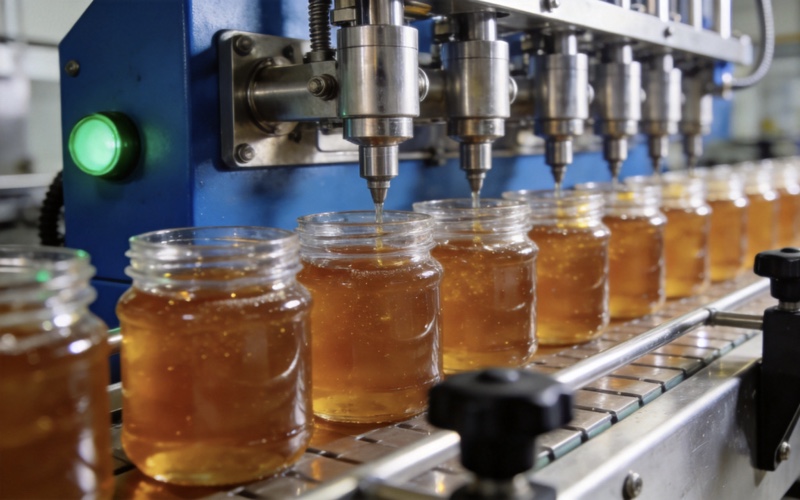
In food and beverage production lines, honey, chocolate, sauce and syrup are both the most common flavour base and one of the more difficult media to convey steadily. They often exist in parallel with flavourings, colourants and acid liquids of low viscosity on the same formulation line: the former has high viscosity and is temperature-sensitive, the latter has small flow and is metering-sensitive. Any pumping scheme must first satisfy three admission conditions — sanitary grade, FDA food-contact materials and CIP in-line cleaning — before flow rate and accuracy are discussed at all.
I. Duty: Two Kinds of Media, One Production Line
Low-viscosity ingredients are mostly water-based, with a viscosity close to water and a small dosage; they require continuous, pulsation-free injection. The viscosity of high-viscosity syrups, honey and chocolate bases can reach thousands to hundreds of thousands of mPa·s, and it changes significantly with temperature — syrup thickens and can even crystallize as it cools, and chocolate starts to set below the process temperature. The viscosity span of one formulation system often crosses several orders of magnitude. Temperature is therefore no longer just a process parameter, it is the precondition for whether the medium can be conveyed at all and whether the metering can be reproduced.
II. Admission Conditions: Sanitary Grade / FDA / CIP
III. Pain Points and Conveying Requirements
Centrifugal pumps lose efficiency in the high-viscosity range and their flow drifts with viscosity; the reciprocating pulsation of plunger or diaphragm pumps easily causes batch-to-batch variation in the filling volume. Uneven insulation causes local cooling, and it becomes normal that "the same rotation speed gives a different flow rate"; a pump body of complicated structure with large dead volume lengthens the CIP time and increases the risk of changeover residue. The core requirements can therefore be summarized in three points: stable flow under viscosity variation, temperature controlled over the whole run, and no residue after cleaning.
IV. Recommended Solution: JONSN DP Series
The DP series is a high-precision gear metering pump designed specifically for medium- and high-viscosity material. It uses a multi-tooth precision gear set with a micrometre-level chamber fit, delivering low pulsation and high linearity. As a positive-displacement pump, its flow is determined mainly by displacement and rotation speed; when the medium viscosity fluctuates within the applicable range, the flow normally does not need to be recalibrated repeatedly — which has real meaning for syrup duties under the temperature difference between the four seasons.
The low shear characteristic brought by low-speed gear meshing also lowers the risk of chocolate and particle-containing sauces being over-sheared, heated up or having their texture changed during conveying. On the system side no additional valves and buffer elements need to be configured, so the piping is shorter and there are fewer stagnation points, which helps shorten the CIP flushing path.
V. Typical Applications
| Application | Medium & Duty | Concerns | DP Configuration |
|---|---|---|---|
| Honey dosing and transfer | High viscosity, prone to crystallization, often needs low-temperature liquefaction | Gentle heating, avoiding local overheating | Electric heating + thermocouple closed loop, low speed and large displacement |
| Chocolate temperature-holding conveying | Melted high-viscosity state, narrow temperature window | Constant temperature, low shear, no setting | Pump body heat tracing + temperature feedback, short pipework |
| Sauce dosing | Particle-containing high-viscosity base, batch proportioning | Quantitative repeatability, particle passability | Displacement selected by viscosity, magnetic coupling seal |
| Syrup temperature-holding conveying | Sucrose / glucose syrup, viscosity varies significantly with temperature | Constant temperature, pulsation-free continuous supply | Positive-displacement metering + temperature control, CIP on changeover |
VI. Quick Selection Reference
| Item | JONSN DP Series (food-grade configuration optional) |
|---|---|
| Applicable viscosity | 100–500,000 mPa·s |
| Displacement | 0.2–100 cc/rev, multiple options |
| Speed / flow | 0–100 rpm; flow = displacement × speed |
| Outlet pressure | ≤ 70 bar (depending on viscosity) |
| Temperature and control | −18–150 ℃; optional electric heating + thermocouple |
| Form of sealing | Mechanical seal / lip seal / packing / magnetic coupling seal |
| Hygiene and cleaning | 316L wetted parts, Ra ≤ 0.8 μm, FFKM (FDA 21 CFR 177.2600); CIP compatible, SIP optional |